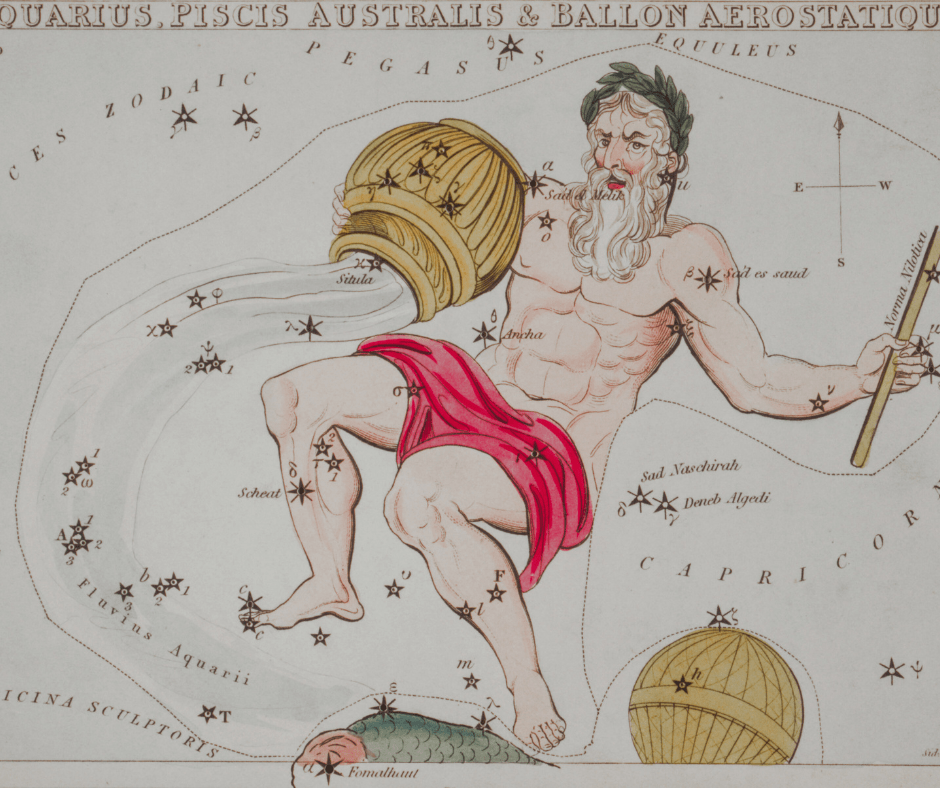
“When the moon is in the Seventh House
And Jupiter aligns with Mars
Then peace will guide the planets
And love will steer the stars…
This is the dawning of the Age of Aquarius”
I first heard about the Age of Aquarius through that dreamy 60s anthem by The 5th Dimension. On account of being a literal child who just thought the retro visuals looked funny, I never really appreciated the song until I heard the Hair version sung in full by the phenomenal Renn Woods.
I was mesmerized by the vocals, of course, but what stuck with me were the lyrics. That’s what actually got me wondering: What is the Age of Aquarius, really?
Why were people already singing about it back in the 60s? Has it been “dawning” for decades? Or longer?
Needless to say, that one song opened a rabbit hole.
And like most rabbit holes in astrology, it goes way back — and I’m talking millennia. Because to understand whether we’re entering a new age now, we need to know what an astrological age even is…and how each one has shaped civilization itself.
In this guide, we’ll explore what astrological ages are, how long they last, how we can trace their influence through history, and what makes this Aquarian shift so complicated (and compelling) to pinpoint.
In This Article
- What is an Astrological Age?
- How Long Is an Astrological Age?
- A Look Back on Past Astrological Ages
- How Astrological Ages Affect Humanity
- Are We Already Living the Age of Aquarius?
- To a New Cosmic Chapter
What is an Astrological Age?
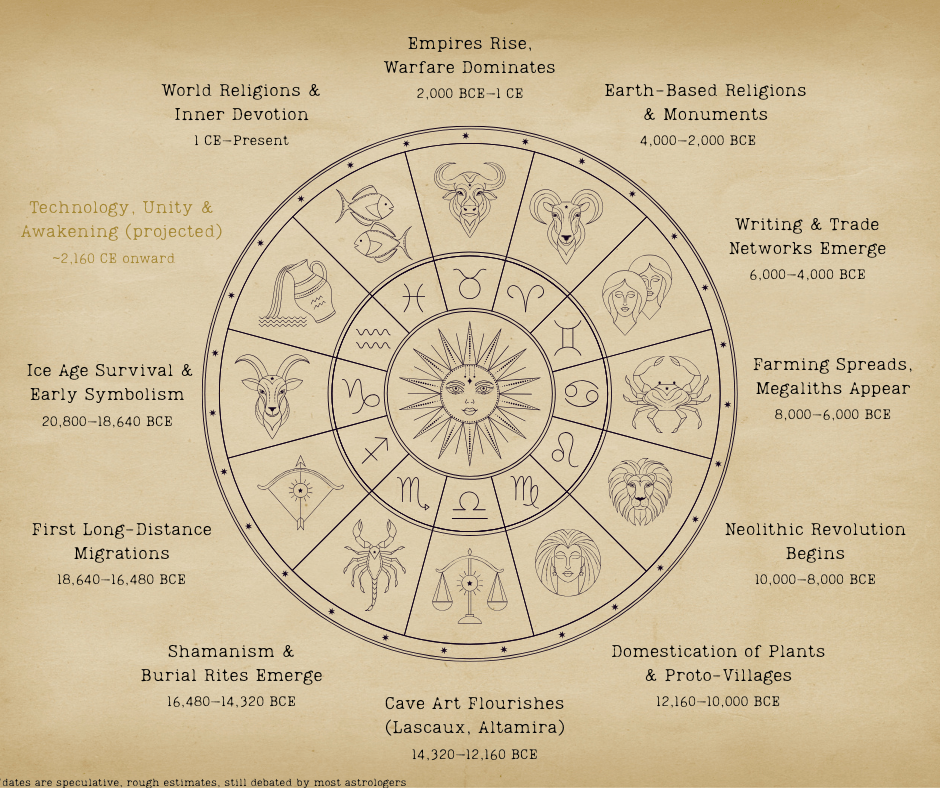
An astrological age is a period of time during which humanity’s “dominant” cultural, political, spiritual, and social energies are colored by the qualities of a specific zodiac sign.
Astrological ages happen because of a slow astronomical phenomenon called the precession of the equinoxes.
As Earth’s axis wobbles over thousands of years, the Sun appears to move backward through the zodiac at the time of the spring equinox.
Each time the Sun shifts into a different zodiac constellation during this key moment, a new astrological age begins.
Think of it like Earth’s “cosmic clock” resetting. As it ticks backward through the signs, an entire age of human civilization changes.
How Long Is an Astrological Age?
Each age lasts around 2,000 to 2,160 years, but the transitions aren’t neat or simple. Obviously, nobody is going to wake up one day and simply announce to the world, “Ah yes, new age unlocked!” (Although people have tried, at least in the form of a catchy 60s musical…)
Instead, the energies of the outgoing and incoming ages overlap for centuries, creating periods of confusion, upheaval, and hybrid cultures.
Kind of like…those really awkward fashion moments between the 90s and 2000s — except on a cosmic level.
Astronomers point out that the true “astronomical” beginning of Aquarius might not happen for another 500 years, based on exact constellation boundaries.
But spiritually, culturally, and socially? Many believe we’re already feeling it.
A Look Back on Past Astrological Ages
Every age leaves a deep imprint on humanity’s collective psyche. If we zoom out over the past several millennia, the fingerprints are everywhere. Let’s walk through the major ages humanity has lived through so far:
The Age of Leo (c. 10,000–8000 BCE)
The Age of Leo coincided with the end of the last Ice Age and the first great leap forward for human civilization. Sun worship was widespread, as the Sun (Leo’s ruler) represented vitality, survival, and divine power.
This was a time of:
- Solar cults, sun temples, and heliocentric myths.
- Burgeoning individualism — the earliest evidence of humans seeing themselves as “creators” and artists.
- Monumental architecture like Göbekli Tepe, hinting at a new form of collective, conscious expression.
The Age of Cancer (c. 8000–6000 BCE)
Cancer, ruled by the Moon, governs nurturing, protection, and emotional security. During this period, humanity began to settle and form deeper emotional and community connections.
Key developments in this era include:
- Transition from nomadic life to agriculture, marking the shift from hunting and gathering to farming, allowing communities to settle permanently and cultivate the land.
- Development of matriarchal systems, with women holding significant roles in both family and spiritual life, reflecting the nurturing and protective qualities of Cancer.
- Worship of goddesses and fertility, with many cultures revering goddesses associated with the Moon, childbirth, and the Earth.
- Focus on community and emotional bonds, as people began to settle into permanent homes, and eventually, the family unit.
- Deep connection to the Earth and water, symbolizing life-giving qualities and the nurturing spirit of the Moon, as water played a central role in sustaining life and agriculture.
The Age of Cancer marked the rise of emotional and communal bonds as the foundation of society. As humanity transitioned to settled life and placed value on nurturing and protection, the stage was set for new cultural shifts — shifts that would be accelerated in the next age, the Age of Gemini.
The Age of Gemini (c. 6000–4000 BCE)
Gemini rules communication, movement, and exchange. Largely fitting for a time when humanity first began weaving webs of connection across land, language, and culture.
This period saw:
- The rise of proto-writing systems like clay tokens and symbolic markings
- Oral traditions thriving as the main way to transmit stories, rituals, and knowledge
- Increasing long-distance trade between settlements, linking different regions and ideas
- The emergence of undeciphered symbols (like the Vinca script) and early pictographs across Europe and the Near East
- Technological developments like the wheel (c. 3500 BCE), enabling greater mobility and exchange
Though full writing systems and the divergence of Proto-Indo-European (PIE) came slightly later, this age set the stage for them.
Symbolic thought deepened, ideas moved farther, and early humans began forming a more connected, conceptual world. With the spark of Gemini, came the beginnings of a collective cultural memory.
The Age of Taurus (c. 4000–2000 BCE)
Ruled by Venus, Taurus embodies fertility, stability, and material wealth, values that were reflected in humanity’s growing connection to the land and nature.
As societies shifted from nomadic lifestyles to agriculture, the era focused on physical security and the abundance of the Earth.
This period saw:
- Widespread reverence for the bull as a symbol of strength, fertility, and renewal
- Ritual use of bull imagery in Neolithic shrines like those at Çatalhöyük
- Agricultural societies deepening their connection to the Earth’s cycles
- Monumental structures like Stonehenge, ziggurats, and pyramids in reverence of cosmic order and seasonal awareness
- The steady growth of trade, settlement, and material culture grounded in land ownership and sustenance.
While the bull wasn’t worshipped universally in the same way, its symbolism stretched from Anatolia to the Indus Valley.
The Age of Taurus was a time of settling, building, and nurturing, laying the foundation for the rise of complex civilizations in the ages to follow.
The Age of Aries (c. 2000 BCE–1 CE)
Ruled by Mars, Aries embodies war, conquest, and heroic action. This era was marked by the rise of empires and the dominance of military-driven expansion, as societies embraced assertiveness, competition, and individualism.
This period saw…
- The dominance of early empires like Akkad, Egypt, and the Indus Valley civilizations
- Monumental campaigns led by figures like Sargon of Akkad, Naram-Sin, and Thutmose III
- Widespread use of war chariots, siege engines, and iron weaponry transforming the battlefield
- The rise of organized armies, standing military systems, and tactical warfare
- Societies that glorified kings, heroes, and divine warriors — often blending statecraft with myth and divine mandate
This was a world shaped by force, where borders were drawn in blood, victory, and survival. But as the age drew to a close, the world began to look not to the sword, but to the soul. The era of belief, sacrifice, and salvation was on the horizon: the Age of Pisces.
The Age of Pisces (c. 1 CE–Present)
Pisces, a water sign ruled by Neptune and Jupiter, governs spirituality, empathy, and illusion. This age marked a turn inward — from empires and conquest to faith, sacrifice, and salvation.
This age brought
- The rise of world religions like Christianity and Islam, both emphasizing personal faith, divine love, and the promise of eternal life
- Religious leaders and imagery associated with fish, including the Ichthys symbol and the title “Fisher of Men” used for Jesus and his disciples
- A widespread focus on emotional devotion, mysticism, and martyrdom, from early Christian saints to Sufi poets and yogic ascetics
- The institutional power of religion, with Christianity spreading through the Roman Empire and Europe, and Islam expanding across the Middle East, North Africa, and Asia
- The persistence and transformation of older faiths like Judaism, Buddhism, and Hinduism, which continued evolving in response to new spiritual movement.
We are technically still within the Piscean Age today. But as the age passes, cracks continue to form.
Disillusionment with organized religion, the rise of secularism, egalitarian thought, and global spiritual searching have, over centuries, hinted that Pisces’ reign draws nearer and nearer to its end.
How Astrological Ages Affect Humanity
Each astrological age brings its own unique energy, shaping not just individual personalities but also the collective mindset of humanity.
These periods influence the way we think, the beliefs we hold, and the very structures of our societies.
They guide our movements, our innovations, and our relationships with the world around us. Though not always immediately apparent, the dominant zodiac sign of each age impacts:
- Religion and philosophy
- Art and architecture
- Politics and societal structures
- Technology and innovation
- How humans see themselves in relation to the cosmos
The dominant zodiac sign doesn’t just bring out its “good” traits — it also challenges humanity with its excesses, shadows, and contradictions. Just like people, ages are messy, complex, and full of lessons.
Today, we’re seeing the shift firsthand: the collapse of old religious orders (Pisces), the rise of technology, humanitarian activism, and collective movements (Aquarius) in the face of tyrannical and oppressive systems.
But with Aquarian ideals also come Aquarian dangers: loss of individuality to technology, cold rationalism over human feeling, and surveillance masquerading as unity.
Are We Already Living the Age of Aquarius?
The long and short of it is: it depends who you ask. We may be in a transitional period between the fading Age of Pisces and the rise of Aquarius. Astrologers remain divided on where exactly we stand.
Why Astrologers Disagree
There’s no unanimous start date. Some astrologers place the dawn of Aquarius centuries in the future, arguing that we won’t officially enter the age until the spring equinox Sun rises fully within the astronomical constellation of Aquarius — which may not occur until around 2600 CE.
Others believe we’ve already crossed this symbolic threshold, citing cultural shifts toward Aquarian ideals as proof we’re well on our way.
One reason for the debate is that constellations don’t have neat borders, and their sizes vary wildly in the sky.
Astrological ages are based on celestial mechanics (specifically the precession of the equinoxes), but the zodiac signs used in Western astrology don’t perfectly match the actual star constellations. So the “start” of an age can’t be pinned down with full consensus.
Signs We’re in a Cusp Phase
Even if we’re not officially “in” the Age of Aquarius, its influence is undeniably showing:
- Technological revolutions (from the internet to AI) have reshaped how we connect, work, and think.
- Social movements in the last century challenging old hierarchies and demanding equity, liberation, and innovation.
- There’s a growing push toward decentralization in media, governance, or finance (cryptocurrency)
At the same time, we’re still working through Piscean themes: ideological polarization, religious extremism, misinformation, emotional escapism, and disillusionment. The Pisces-to-Aquarius handoff is generational, messy, and overlapping.
So…Where are We?
We’re likely living in the threshold. Not fully Aquarian, but no longer fully Piscean either, and it might stay this way for generations beyond our lifetimes.
Some astrologers describe this as an “in-between age”, a kind of cultural and spiritual adolescence where the structures of the old age are dissolving, but the new ones haven’t quite taken shape.
To a New Cosmic Chapter
Even if you’re more of a skeptic, it’s hard to ignore how often major shifts in human history seem to echo the symbolism of the stars and seasons.
The alignment between astrological ages and cultural evolution might not be something science can easily measure, but it still sparks something in you.
That sense of wonder and curiosity certainly feels fitting for the moment we’re meant to live in now: a slow, collective step into something different.
Perhaps not exactly the utopia of peace and love that the 5th Dimension song would have us believe, but a chance to rethink how we move through the world, together.
If you’re intrigued by how the cosmos plays into our everyday lives, check out my Astrology Resources for more insights into the planets, signs, and cycles that shape us all.
✨ Enjoyed this post? Save it for later! ✨
Pin the image below to your favorite tarot or spirituality board on Pinterest! 📌🔮



Leave a comment