Even if you’re not an astrology expert, chances are you’ve heard it floating around that there’s a new zodiac sign. Suddenly, there are 13 signs instead of 12. You’re no longer a Leo—you’re a Cancer. You’re no longer a Scorpio—you’re…what the heck is Ophiuchus?
Let’s clear things up right away: No, you’re still a Virgo, I’m still an Aquarius – and all that debate actually comes down to a very simple misunderstanding.
So if you’re here, you’re probably wondering why people keep insisting on this mysterious 13th sign? What even is Ophiuchus?
Let’s get into it.
In This Article
- What Is Ophiuchus, Anyway?
- Is Ophiuchus Part of the Zodiac Signs?
- Why People Think Ophiuchus is a Thing Now
- The “13-Sign” Zodiac Calendar
- Wait… There’s a 14th Zodiac Sign?
- Why Ophiuchus Just Doesn’t Work
- Are You Still Your Sun Sign?
What Is Ophiuchus, Anyway?
Ophiuchus (pronounced oh-FEW-kuss) is a real constellation. The name comes from the Ancient Greek ὀφιοῦχος (ophioûkhos), meaning “serpent-bearer.” It’s often depicted as a man holding a snake (which itself is represented by a nearby constellation called Serpens).
The idea of Ophiuchus has been around for a long time. It was included in the 2nd-century star catalog of the astronomer Ptolemy, and today, it’s one of the 88 modern constellations officially recognized by astronomers.
Ophiuchus has been connected with several mythological figures over time, most famously Asclepius, the healer in Greek mythology.
According to legend, he discovered how to bring people back from the dead after observing a snake revive another snake with herbs. That didn’t sit well with the gods (immortality for mortals was a big no-no), so Zeus struck him down with a lightning bolt—but honored his talents by placing him in the stars.
So yes, it’s a real constellation. But…
Is Ophiuchus Part of the Zodiac Signs?
Short answer: no, at least not in Western astrology.
The zodiac as we know it today is made up of 12 signs, and that number is not random. It’s built around the 12-month solar calendar, the 12 lunar cycles, and most importantly, the 12 divisions of the sky along the ecliptic—the apparent path the Sun travels through the sky over the course of the year.
Yes, the Sun does pass through Ophiuchus for a short time—about 18 days from late November to mid-December. But the Babylonians, who helped shape early Western astrology, already knew about Ophiuchus over 2,000 years ago—and chose not to include it.
They wanted the zodiac to align with the 12-month calendar, creating a symbolic and symmetrical framework. So it wasn’t really “removed,” so much as it just never made the cut.
Why People Think Ophiuchus is a Thing Now
This all boils down to the precession of the Earth’s rotation, which causes the stars to shift position over thousands of years.
Because of this, the constellations are no longer aligned with the astrological signs they were named after. This misalignment is sometimes used to argue that astrology is outdated or inaccurate.
In 2011, a newspaper article claimed that NASA had updated the zodiac, “adding” Ophiuchus and shifting everyone’s signs after 3000 years.
As you would imagine, the headline blew up—and the story was reported (and misreported) by thousands of websites, outlets, and Facebook pages over the years
NASA would repeatedly clarify that they were simply describing how astronomy observes the constellations—not how astrology works.
And yet, the myth resurfaces every few years, especially in 2016 and again in 2020, sparking viral panic (and headaches among tropical astrologers) every now and then.
But Western astrology doesn’t actually use the literal positions of the stars. That’s sidereal astrology (practiced in Vedic traditions), which I have actually covered in a previous article.
Western astrology is based on the tropical zodiac, which follows the seasons and the equinoxes, not the current location of constellations in the sky. So even though the Sun technically passes through Ophiuchus, that doesn’t affect your birth chart.
The “13-Sign” Zodiac Calendar
Hypothetically, let’s say we wedge Ophiuchus into the zodiac—what would that even look like?
Here’s how the 13-sign zodiac calendar would shift, based on the International Astronomical Union (IAU)’s dates:
| Sign | Dates (13-Sign Zodiac) |
| Capricorn | January 20 – February 16 |
| Aquarius | February 16 – March 11 |
| Pisces | March 11 – April 18 |
| Aries | April 18 – May 13 |
| Taurus | May 13 – June 21 |
| Gemini | June 21 – July 20 |
| Cancer | July 20 – August 10 |
| Leo | August 10 – September 16 |
| Virgo | September 16 – October 30 |
| Libra | October 30 – November 23 |
| Scorpio | November 23 – November 29 |
| Ophiuchus | November 29 – December 17 |
| Sagittarius | December 17 – January 20 |
In this version, Scorpio barely spans a week, while Ophiuchus is sandwiched between Scorpio and Sagittarius. But this entire calendar is astronomical, not astrological. It’s not used by any major astrological tradition.
It’s also worth noting that even 13-sign sidereal astrologers can’t agree on Ophiuchus’ exact dates. Some assign it from Nov 29 to Dec 27, others from Dec 6 to Dec 31 using an expanded “14-sign system.”
Wait… There’s a 14th Zodiac Sign?
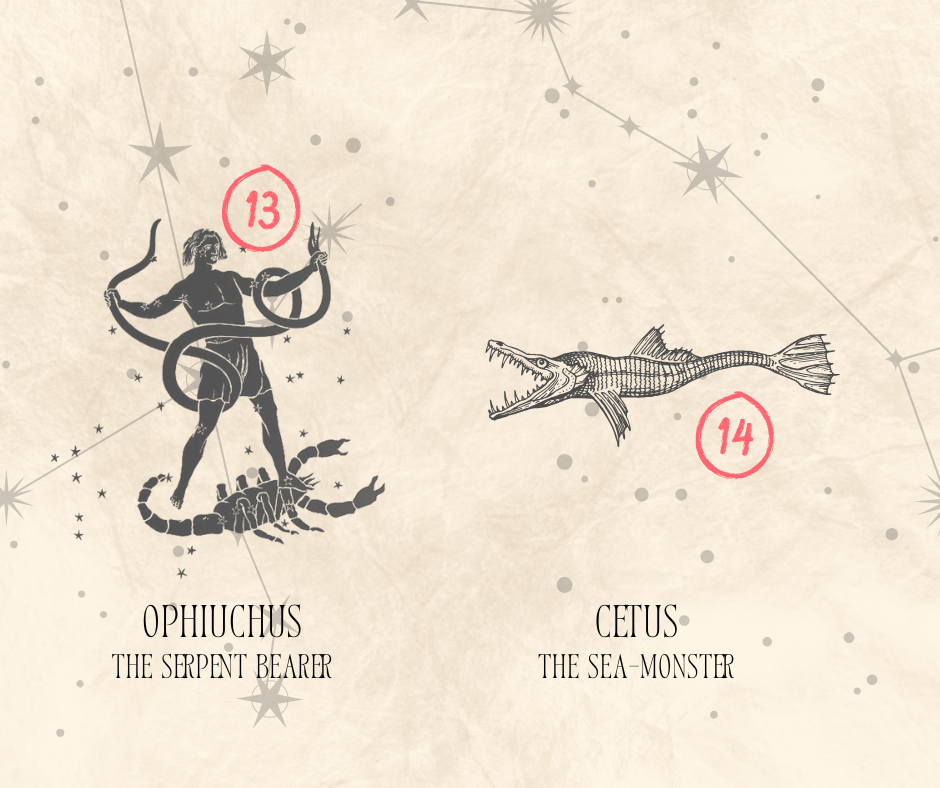
Believe it or not, yes. In 1970, astrologer Steven Schmidt also proposed a 14-sign zodiac that included Cetus, a sea-monster constellation that briefly intersects the ecliptic. Sometimes depicted as a whale, Cetus lives near Pisces and Aquarius. Like Ophiuchus, it does technically cross the ecliptic.
But before you start checking your chart for sea-monster energy:
- Cetus is barely touched by the Sun—only about a day or two—and doesn’t have clear seasonal markers.
- It’s not recognized by traditional or modern astrologers.
- And unlike the 12 signs, Cetus has no ruling planet, mythology integrated into astrology, or defined characteristics.
Still, for funsies, here’s how the zodiacs compare side-by-side:
| Constellation | Tropical Dates | Sidereal (Lahiri) | Schmidt’s Equal-Length Dates |
| Aries | Mar 21 – Apr 19 | April 14 – May 14 | April 16 – May 11 |
| Cetus | — | — | May 12 – June 6 |
| Taurus | Apr 20 – May 20 | May 15 – Jun 15 | June 7 – July 2 |
| Gemini | May 21 – Jun 20 | Jun 16 – Jul 16 | July 3 – July 28 |
| Cancer | Jun 21 – Jul 22 | Jul 17 – Aug 16 | July 29 – Aug 23 |
| Leo | Jul 23 – Aug 22 | Aug 17 – Sep 16 | Aug 24 – Sep 18 |
| Virgo | Aug 23 – Sep 22 | Sep 17 – Oct 16 | September 19 – October 14 |
| Libra | Sep 23 – Oct 22 | Oct 17 – Nov 15 | October 15 – November 9 |
| Scorpio | Oct 23 – Nov 21 | Nov 16 – Dec 15 | November 10 – December 5 |
| Ophiuchus | — | — | December 6 – December 31 |
| Sagittarius | Nov 22 – Dec 21 | Dec 16 – Jan 14 | January 1 – January 26 |
| Capricorn | Dec 22 – Jan 19 | Jan 15 – Feb 12 | January 27 – February 21 |
| Aquarius | Jan 20 – Feb 18 | Feb 13 – Mar 14 | February 22 – March 20 |
| Pisces | Feb 19 – Mar 20 | Mar 15 – Apr 13 | March 21 – April 15 |
You’ll notice that these dates are also different from the official dates recognized by the IAU, which mapped the Sun’s actual transit through each constellation based on precise astronomical boundaries.
So yeah. There’s the 12-sign system, the 13-sign controversy, and the 14-sign… uh, sea monster edition. The stars may not stay put, but that’s why astrology is primarily a symbolic system—not a literal map of the sky.
Why Ophiuchus Just Doesn’t Work
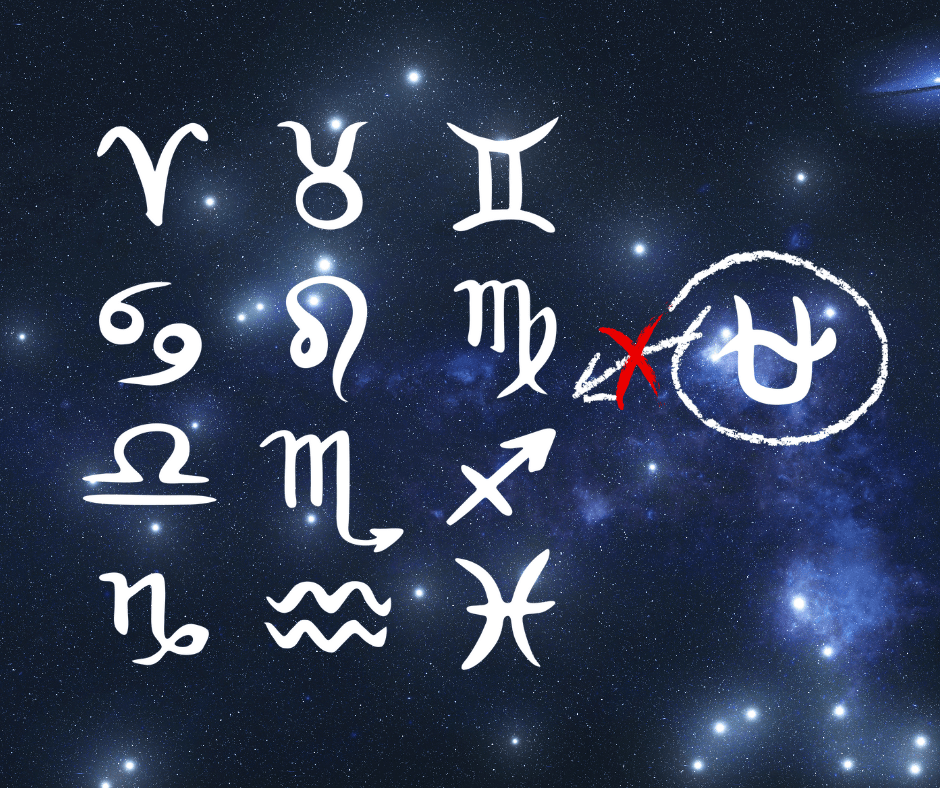
Let’s say it one more time: Ophiuchus is a real constellation, but not a real zodiac sign. The Babylonians knew about its existence all those centuries ago and still chose the 12-sign system.
The twelve signs aren’t just picked at random; they each have specific elements, modalities, and planetary rulers, forming six key pairs of oppositions. It’s a balanced framework where each of the 12 signs has an opposite and a complementary role:
- Cancer (Water) ↔ Capricorn (Earth)
- Aries (Fire) ↔ Libra (Air)
- Gemini (Air) ↔ Sagittarius (Fire)
Another reason is that Western astrology doesn’t rely on constellations. It relies on seasonal markers, like the Spring Equinox (Aries) and Autumn Equinox (Libra), and divides the year into 12 equal parts based on the Sun’s path.
Adding Ophiuchus throws that balance off. It doesn’t have an agreed-upon element (some say Fire, but that’s disputed), and it lacks a clear planetary ruler. Its symbolic meaning doesn’t fit into the established system of twelve archetypes.
Even in sidereal astrology, which aligns more with star positions, Ophiuchus isn’t part of the widely used Lahiri ayanamsa or other mainstream systems. Even with axial precession, its influence on astrology is close to nil, as it barely touches the ecliptic.
If you were born between November 29 and December 17, you might find yourself on the Ophiuchus list. But unless you’re practicing a fringe or experimental version of astrology, you’re still a Sagittarius or a late Scorpio—not an Ophiuchus.
Are You Still Your Sun Sign?
Whether you follow a Western or Sidereal system, the answer is: yes. Yes, you are. Unless you personally decide to follow a sidereal system that includes Ophiuchus (and there are a few people who do), your zodiac sign hasn’t changed.
Astrology is a tool for understanding energy, identity, and cycles that influence you and the world around you. If Ophiuchus speaks to you on a symbolic level, explore it! But in terms of structure, balance, and tradition—the zodiac remains a wheel of 12.
So rest easy, star babies. No need to update your birth chart just yet.
Want more astrology deep dives like this? Check out the rest of my blog, where I cover all sorts of topics and applications of astrology. I’m also continually building a library of resources on tarot and astrology, like my Planets in Astrology guide! Don’t be shy, take a look around, see what you like!
✨ Enjoyed this post? Save it for later! ✨
Pin the image below to your favorite tarot or spirituality board on Pinterest! 📌🔮


Leave a comment