When you’re deep-diving into your birth chart and notice a cluster of planets hanging out in the same zodiac sign or house, you might be looking at what astrologers call a stellium.
If you were anything like me the first time I heard of it, you might have zero idea what that even means.
It’s one of those chart details that astrology learners tend to discover after the basics. But the more you learn, the more you realize: a stellium can say a lot about your personality, focus in life, and even how transits hit you.
In this post, I’ll walk you through the real deal on stelliums—what they are, how to spot them, and what they might mean if you have (or don’t have) one.
In This Article
- What is a Stellium in Astrology?
- Stellium in a Sign vs Stellium in a House
- What a Stellium Might Say About You
- Is It Rare to Have a Stellium?
- How to Read Your Stellium Like an Astrologer
- Can You Have More Than One Stellium?
- What If You Don’t Have a Stellium?
- Let Your Stellium Guide You, Not Define You
What is a Stellium in Astrology?
In astrology, a stellium is a group of three or more planets in the same zodiac sign or astrological house. Some astrologers are a bit stricter on definitions, and say you need four or more planets, or that they have to be within a certain degree range (usually 8–10 degrees apart) to really count.
There are also varying opinions on which planets matter. Most astrologers agree that a true stellium needs at least three personal or social planets—like the Sun, Moon, Mercury, Venus, Mars, Jupiter, or Saturn.
While outer planets (Uranus, Neptune, Pluto) can be part of the mix, they don’t usually drive the emotional or conscious expression of the stellium unless they’re tied to something more personal.
Some astrologers also count the Ascendant or Midheaven, but only if they’re involved in a conjunction with planets. Otherwise, they’re out too.
So in summary:
- 3 or more planets (4+ if going by traditional rules)
- In the same sign or same house
- Close degrees = stronger effect
- Personal/social planets matter most
Either way, a stellium focuses a ton of energy into one area of your chart. It’s like putting a spotlight on a specific part of your personality, identity, or life story.
Stellium in a Sign vs Stellium in a House
A stellium in a sign amplifies that sign’s archetypal traits. For example, someone with a Cancer stellium may naturally be nurturing, protective, emotionally intense, and intuitive.
A stellium in a house concentrates energy into a specific area of life. A 10th House stellium may point to career obsession, public visibility, or a big drive for legacy and achievement, regardless of what sign it’s in.
Sometimes the sign and house line up perfectly (say, a Leo stellium in the 5th House), but not always. You might have a Capricorn stellium in the 7th House, which means that ambitious Capricorn energy will be mingling with the house’s themes of partnership and cooperation.
| Pro Tip: If your stellium spans two signs or two houses, pay attention to where the majority of the planets fall. That part will likely dominate. |
What a Stellium Might Say About You
The more planets in a stellium, the stronger it feels in your chart. That sign or house will play a major role in shaping:
- Your sense of self
- Your personality and habits
- Your relationships and goals
- The themes you revisit throughout life
It can even explain why you act so much like one sign even if it’s not your Sun. For example:
- You’re a Virgo Sun, but people swear you give off Scorpio vibes — oh, turns out you have a 4-planet Scorpio stellium.
- Your Moon, Mercury, and Venus are all in Libra in the 11th House — you may be especially social, diplomatic, and deeply focused on community or justice.
In short, your stellium shows where a lot of your energy is focused. It doesn’t override the rest of your chart, but it does add weight to that specific sign or house—and that influence will show up again and again in your life.
Is It Rare to Have a Stellium?
Not especially—but it’s still notable.
Having three or four planets close together in the same sign or house is something a decent number of people have, especially if they were born during a time when Mercury, Venus, and the Sun were naturally clustered. This happens often since Mercury and Venus never stray far from the Sun.
But a stellium that includes Mars, Jupiter, Saturn, or the Moon? Or one that’s fully packed in a single house, like the 8th or 12th? That’s more telling.
So while it’s not unicorn-level rare, it’s not the norm either—and it definitely sets a tone for your chart.
| Fun Fact: The Moon moves through a sign every 2.5 days, so catching it in a stellium with other planets depends a lot on timing. A Moon-included stellium often makes emotional patterns stronger and more noticeable. |
How to Read Your Stellium Like an Astrologer
If you’ve spotted a stellium in your chart, here’s how to make sense of it:
Step 1 – Start with the sign and house
- The sign shows how the energy plays out in your stellium.
- The house tells you where in life that energy shows up most. For example, a Scorpio stellium in the 5th house might suggest intense creative drive or emotional themes around pleasure, romance, or children.
Step 2 – Look at which planets are involved
Your stellium’s meaning really comes down to which planets are grouped together. Different combos highlight different parts of your personality or life story—some louder, some more subtle.
Here are a few examples to get you thinking:
- Venus + Mars → Creative energy, strong passions, or drive in love & art
- Mercury + Saturn → Sharp intellect, serious and structured communication
- Sun + Jupiter → Big personality, natural affinity for teaching and leadership
The types of planets involved also shift how the stellium plays out.
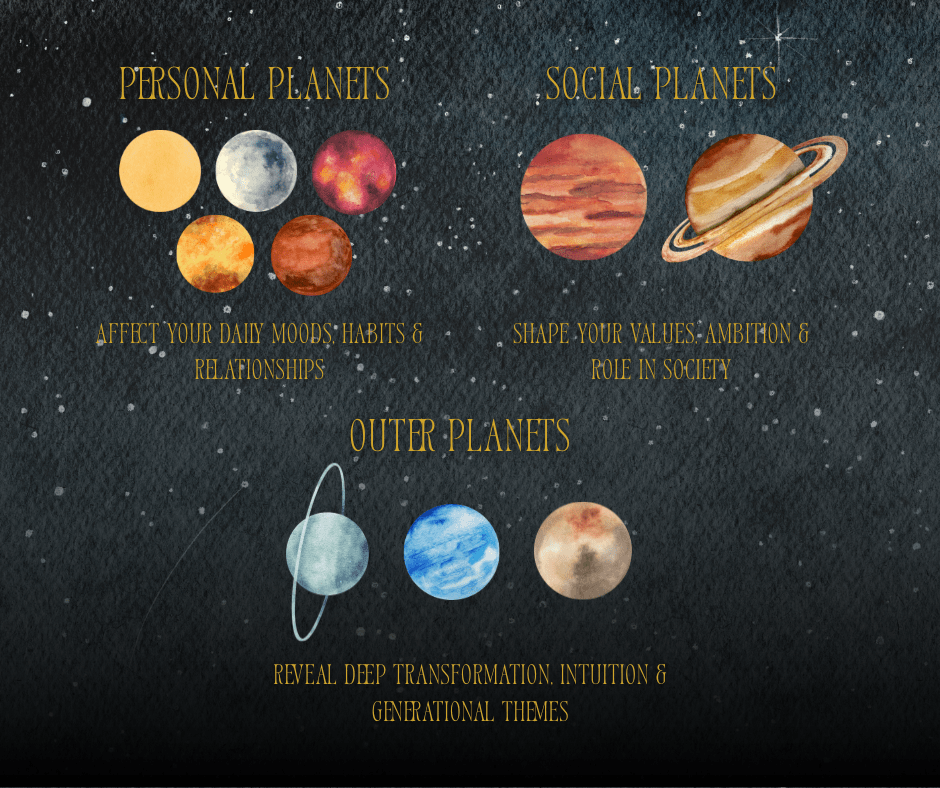
- Personal planets (like Mercury, Venus, or Mars) tend to show up in your everyday moods, behaviors, and relationships.
- Social planets (like Jupiter and Saturn) reflect how you interact with society and handle long-term goals.
- Outer or generational planets (like Uranus, Neptune, and Pluto) point to deeper spiritual, psychological, or even karmic themes.
If you want a more in-depth look at each planet (and so much more heavenly bodies), check out my resources on the Planets in Astrology!
Step 3 – Check the aspects
- Are the planets working in harmony (conjunctions, trines)?
- Are they under pressure (squares, oppositions)?
- Are they aspecting other key placements in your chart (Ascendant, Moon, MC)?
Tight aspects—especially to planets outside the stellium—can pull the energy in a new direction or trigger the entire stellium when activated by transits.
Step 4 – Identify the key players in the stellium
Not every planet in a stellium acts equally. Some will dominate the conversation. Here’s what to look for:
- Alpha Planet – This is usually the strongest planet based on dignity (rulership/exaltation), aspects, or your dominant chart ruler. Sets the tone for how the stellium operates.
- Lead Planet – The one in the earliest degree of the stellium. Think of this as your stellium’s “first responder”—it gets hit by transits first and often shapes your initial reaction to things.
- Last Planet – The one in the latest degree. Symbolizes the goal or lesson of the stellium—how you grow through that concentrated energy.
- Middle Planet – Near the center of the group. It might get lost in the mix, but it quietly carries weight and keeps things cohesive.
- Lone Planet – Slightly farther apart from the cluster (but still in the same sign or house). It might feel like an outsider and act more independently, especially during tough transits.
Confused? Let’s try out a quick exercise to see all this in action. Let’s say someone has this lineup in Pisces, this is how you would break down each planet:
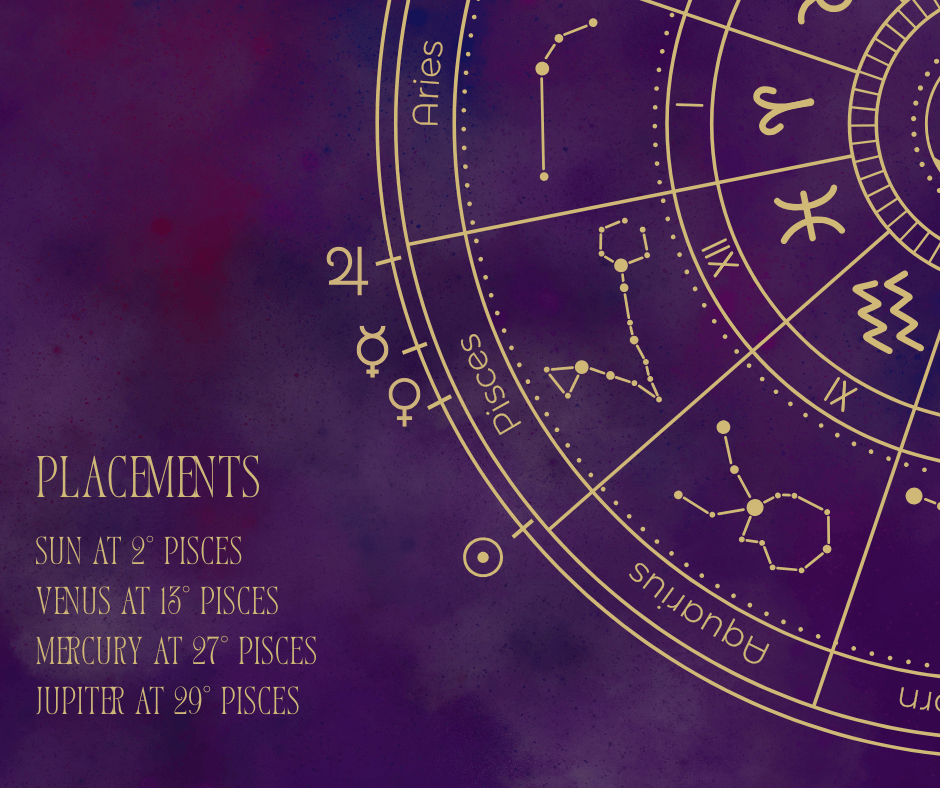
- Sun at 2° Pisces – Lead Planet. It’s the first to respond when this stellium is activated, but sits a bit farther from the rest, making it the Lone Planet too. This person may strongly identify as intuitive and creative but still feel separate from their deeper emotional needs.
- Venus at 13° Pisces – Middle Planet. Quiet but influential. Venus is exalted here, so this placement harmonizes the group and strengthens emotional expression through love, art, or idealism.
- Mercury at 27° Pisces – Struggles in Pisces due to detriment. This placement may bring dreamlike, nonlinear communication that enriches the imagination but might need grounding from time to time.
- Jupiter at 29° Pisces – Last Planet and Alpha Planet, as it rules Pisces. This sets the spiritual tone of the stellium. The end goal here might be compassion, faith, or deep emotional wisdom.
This setup shows how a stellium isn’t just a cluster—it’s a system. Each planet plays a role, and the strongest one often gives the whole group its mission.
Step 5 – Watch the transits
One of the biggest reasons stelliums matter is because when a heavy transit (like Saturn, Pluto, or even Mars) hits one planet, it often hits all of them.
This can feel like a full-on identity crisis or breakthrough, depending on what’s involved.
Knowing which planet gets hit first (lead) or hardest (alpha or lone) can help you work with the energy instead of getting steamrolled by it.
Can You Have More Than One Stellium?
Yep! Some charts have multiple stelliums—especially if they have both sign-based and house-based ones.
For instance, you could have:
- A Leo stellium in the 2nd House (personal values + self-expression)
- A Pisces stellium in the 7th House (spiritual partnership themes)
This kind of setup can become a source of both strength and tension. You may feel like you’re being pulled in several directions, or that you’re juggling different identities or missions in life.
What If You Don’t Have a Stellium?
Having no stellium doesn’t make your chart any less meaningful or “balanced.” In fact, it might make your life path feel more flexible or evenly distributed across multiple areas.
Where stelliums bring an intense, focused energy, non-stellium charts often bring a sort of versatility to your personality and life path. You may be someone who wears many hats, adapts to different environments, and evolves through various life chapters rather than a single-focused story.
Either way, both types of charts are valid. One isn’t better than the other—they just point to different kinds of strengths.
Let Your Stellium Guide You, Not Define You
If your chart has a stellium, it deserves your attention. It’s a core feature that shapes how you see the world and how you move through it. It can explain a lot—from your obsessions to your biggest life lessons.
But astrology is always about the bigger picture. Your stellium might be powerful, but it doesn’t cancel out the rest of your placements. Everything in your chart works together.
So instead of getting too fixated on one cluster, let it be a starting point. Learn what it’s trying to teach you, and see how it connects with the rest of your chart.
Want to explore your placements deeper? Check out the Planets in Astrology and Zodiac Signs Guide on Girl With The Stars. And if you haven’t yet pulled your natal chart—what are you waiting for?
✨ Enjoyed this post? Save it for later! ✨
Pin the image below to your favorite tarot or spirituality board on Pinterest! 📌🔮



Leave a comment